-
Human Creativity in the AI Era: Why the Top 10% Will Always Outpace Machines (2026)AI Trends & Insights 2026. 4. 5. 15:08GoodTech AI · 5 min read

A few years ago, a major American fast-food chain installed an AI ordering system at its drive-throughs. Customers asking for a coffee would find ice cream added to their order. Repeating the same words twice produced entirely different results. The system was eventually pulled.
That story felt reassuring at first. But the reassurance did not last long. Because it turned out that while AI struggled to take a drive-through order, it was rapidly getting very good at report writing, drafting proposals, and analyzing data — work that many of us have spent years building expertise in.
So the question shifted: not "Will AI replace me?" but "What can AI not replace?"
In 2025, a research team at the University of Montreal set out to answer exactly that. They ran a large-scale creative thinking assessment with 100,000 human participants alongside GPT-4, Claude, and Gemini (Scientific Reports, 2025). The results were striking in both directions.
Some AI models already exceeded the average human creativity score. That part got the headlines. But the full picture matters more: the top 50% of human participants outperformed every AI tested. And the top 10% maintained a substantial lead that no model came close to closing.
The conclusion is precise: AI has surpassed average human creativity. It has not touched the upper range of human creative ability.
This raises an important follow-up: what separates the top 10% from the average — and how do you get there?
Table of Contents
1. Why AI Gets Stuck at Average
2. Creativity Is Connection: What Einstein Proves
3. Lessons from Monet and John Cage
4. The Real Risk: Letting AI Do All Your Thinking
5. 3 Ways to Protect and Build Your Creativity
6. FAQ
Why AI Gets Stuck at Average

To understand why AI creative output tends toward the middle, you need to understand what AI is fundamentally doing. Every response an AI generates is a statistically informed prediction: given everything it has learned, what is the most plausible continuation of this input?
That is an extraordinary capability for many tasks. But it is also a structural ceiling on originality.
Christian Terwiesch, a professor at Wharton Business School, described the dynamic clearly in a 2025 study:
"If ChatGPT is used as the sole creative advisor, the ideas will soon run out because they are too similar to each other. The AI model tries to average out the most likely completion based on the given input."His research found that groups using ChatGPT for creative ideation produced individually higher-quality ideas — but across the group, the ideas converged. Different people ended up generating similar outputs. Diversity of thought collapsed. (Wharton Business School, 2025)
This pattern has shown up in creative industries globally. When AI-generated content flooded online platforms, audiences began noticing a sameness — technically competent work that felt emotionally thin. In South Korea, AI-generated webcomics prompted a reader backlash when the content felt indistinguishable from other AI work. Major platforms responded by restricting competition entries to human-created work. Audiences sensed the absence of something they could not always name: genuine perspective.
Dimension AI Creativity Human Creativity Starting point Patterns in past data Personal desire and conviction Output The most statistically probable answer New territory beyond existing patterns Driver Optimization within known space Emotion, lived experience, culture Ceiling Cannot originate outside trained
distributionCan break the pattern itself AI builds a better average. Creativity starts where the average ends.
Creativity Is Connection: What Einstein Proves

Steve Jobs defined creativity as "connecting things." Philosopher David Bohm described its result as "creating a harmonious, whole, and beautiful order."
Einstein is the cleanest proof of both definitions.
He took two concepts that no physicist had joined before — time and space — and connected them into a single unified framework: spacetime. The Special Theory of Relativity (1905) did not emerge from finding a pattern in existing data. It came from a question Einstein had held for years: what would it feel like to ride alongside a beam of light?
That question was not in the data. It came from Einstein's particular obsession — what you might call a deep personal aspiration. The eventual answer reshaped physics, enabled atomic clocks, and made GPS possible.
An AI trained on thousands of physics papers would be excellent at summarizing the state of physics as of its training date. It would not generate the concept of spacetime for the first time, because that concept did not exist in the data yet. It had to be created — and creation, at its root, comes from desire, not distribution.
This maps neatly onto Maslow's hierarchy of needs. Each major technological era has pushed humanity up the ladder. The Industrial Revolution met basic physiological and safety needs at scale. The internet era addressed belonging and esteem. The argument now is that AI could be the tool that enables self-actualization — not by thinking for us, but by clearing away enough routine work that we have real space to think for ourselves.
The paradox of AI is that it could either accelerate or suffocate this development, depending entirely on how we use the time it frees up.
Lessons from Monet and John Cage: What Creative Thinkers Have in Common
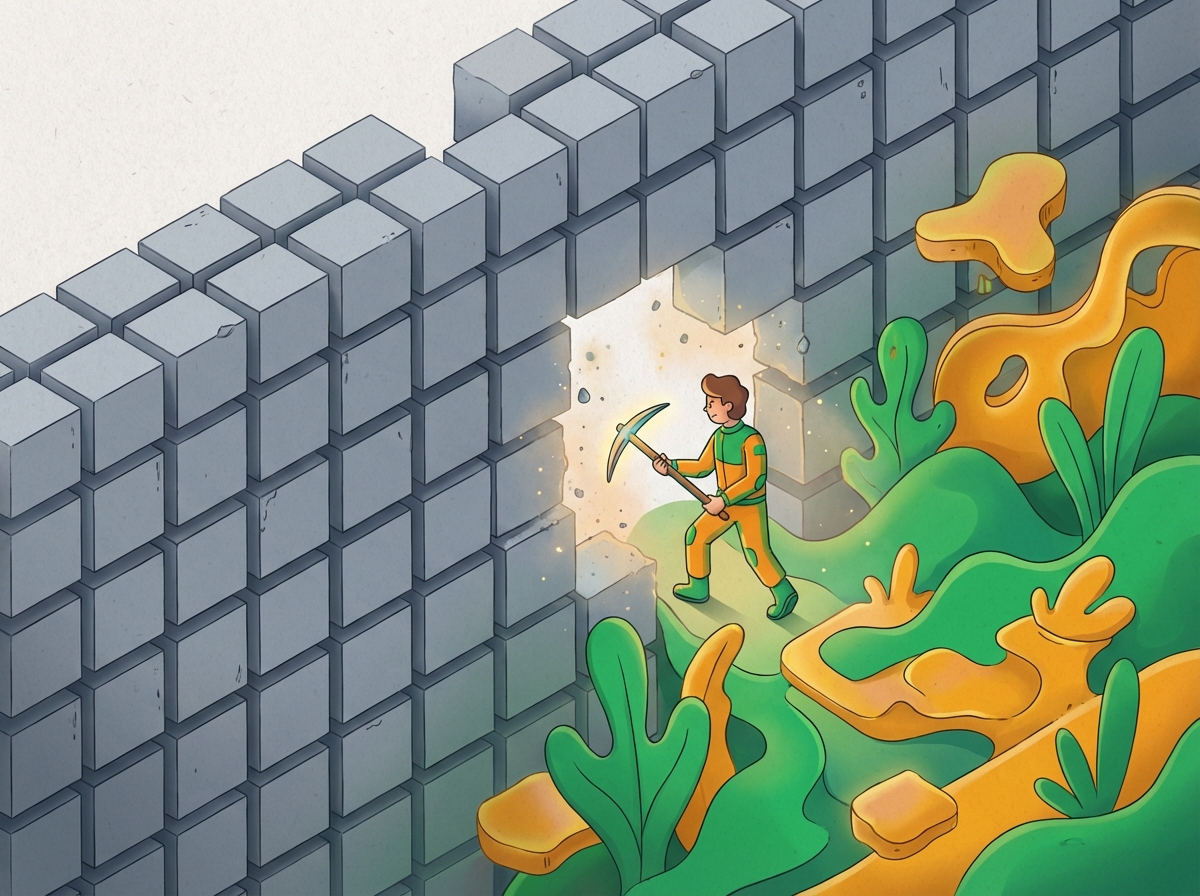
What do the people who land in the top 10% actually do differently?
Claude Monet was working in 19th-century France, when the art establishment expected painters to depict churches and mythological scenes. The prevailing style had been trained, through centuries of patronage and tradition, to produce a particular kind of output. Monet sat alone in front of a pond of water lilies. He trusted what he personally found beautiful: natural light on water. Impressionism was not a trend he followed. It was something he initiated by refusing the data set entirely.
An AI trained on that same art-historical corpus would have produced a technically accomplished church painting, well-averaged across thousands of examples. Monet stepped outside the corpus.
John Cage did something even more radical. In 1952, he premiered a composition called 4'33" — four minutes and thirty-three seconds during which the performer sits at an instrument and plays nothing. What the audience hears is the ambient sound of the room: chairs shifting, people breathing, wind, traffic. Cage was declaring that all of it is music. This idea was not derivable from any existing musical data. It required someone willing to question the definition of the category itself.
James Kaufman, a professor of educational psychology at the University of Connecticut, frames the distinction this way (UConn Today, January 2026):
"AI is excellent at generating ideas, but evaluating which ideas are worth pursuing, and making the judgment call about direction — that remains a human responsibility. Creativity requires more than idea generation."The common thread across Monet, Cage, and Einstein is not genius in the popular sense. It is the willingness to hold a personal conviction strongly enough to go somewhere the existing data does not point. And conviction, by definition, cannot be averaged.
The Real Risk: What Happens When You Let AI Do All Your Thinking

A 2024–2025 survey of working professionals asked respondents to identify the most important skill for the AI era. Creativity and innovation ranked first at 37.1% — ahead of communication and collaboration (34.9%) and AI proficiency itself (34.3%).
Even the people who use AI most effectively recognize that creativity is what matters most.
But a separate government survey of AI users in 2025 found that 60.4% identified declining creativity as the biggest downside of generative AI — more than misinformation, privacy concerns, or job displacement.
This is the central tension. AI frees up time. But if the freed-up time goes toward consuming more content, doing more shallow tasks, or simply outsourcing more thinking, the net effect on creativity is negative.
Frank Herbert's science fiction novel Dune opens with a civilization that banned thinking machines — not because the machines failed, but because humans who delegated all their thinking eventually lost the capacity to think. Herbert called this the Butlerian Jihad. The warning is not that AI will revolt. It is that the atrophy happens quietly, through convenience.
The question is not whether to use AI. The question is what you do with the time AI gives back.
3 Ways to Protect and Build Your Creativity Right Now
1. Use AI for repetitive work, not directional thinking— Let AI handle research, summarization, formatting, and first drafts. Reserve the question ofwhatto create andwhyfor yourself. The moment you ask AI "what should I do?" you have outsourced the part of the work that builds creative muscle.2. Invest reclaimed time in human thinking— If AI saves you 30 minutes on a task, do not immediately fill that 30 minutes with more tasks. Spend some of it thinking without a screen. Talk to a colleague about something you do not yet understand. The connections that drive original ideas form in unstructured time.3. Set direction yourself, then hand off execution— Instead of prompting AI with "write me something about X," try "here is the angle I want to take, here is why I think it matters, now help me develop it." This keeps creative ownership with you and uses AI as a craft amplifier rather than a direction-setter.The goal is not to avoid AI. It is to remain the person who decides what is worth making — and why.
Start small. Ten minutes at lunch, away from any screen, asking yourself: what do I actually want to create? What connection am I trying to make?
Monet, Cage, and Einstein did not begin by breaking all the rules. They began by paying close attention to what they personally found compelling — and refusing to let the existing data talk them out of it.
FAQ
Q. Has AI actually been proven to outperform humans creatively?Partially. The 2025 University of Montreal study (Scientific Reports) tested 100,000 humans against GPT-4, Claude, and Gemini on standardized creative thinking tasks. Some AI models exceeded the average human score. However, the top 50% of human participants outperformed all AI, and the top 10% maintained a significant gap. AI has surpassed average human creativity — not human creativity at its best.Q. Does using AI make you less creative over time?There is reason for concern. A 2025 government survey of AI users found 60.4% identified creativity decline as the top downside of generative AI. The Wharton study found that groups relying heavily on ChatGPT for ideation converged on similar ideas — a phenomenon called creative homogenization. The risk is not AI itself but how the saved time is spent. Using AI for execution while preserving your own directional thinking appears to protect creative capacity.Q. What is the most effective way to build creativity in the AI era?Use AI to eliminate routine cognitive load, and redirect that freed-up energy toward the things AI cannot do: making unexpected connections, holding a strong personal conviction, asking questions that do not yet have answers. Creativity grows through unstructured thinking time and genuine engagement with problems — neither of which AI can substitute.
Sources: University of Montreal / Scientific Reports (2025) — 100,000-person creativity study; Wharton Business School, Christian Terwiesch (2025) — AI creative ideation research; UConn Today, James Kaufman (January 2026) — AI and creative judgment; South Korean Ministry of Science and ICT, Intelligent Information Society User Panel Survey (2025
GoodTech AITechnology for good, one person at a time'AI Trends & Insights' 카테고리의 다른 글